The Riedel Research Office was not born from a programme, but from a question: what does it mean to build on shifting ground?
Set within the oak-covered hills of Greenbrae, California, this project for a global financial analytics firm became an exploration of dynamic systems, whether geological, climatic, or economic, and of architecture’s ability to bring them together within a suspended moment.
The site rests on Franciscan mélange, a tectonic memory written directly into the layers of the terrain. The client’s company operates across fifteen countries within a continuous cycle of activity. Above it, the oak grove has existed for centuries.
Three systems. Three distinct temporalities. One discreet building charged with bringing them into relation.
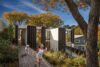
Riedel Research Group Office
Where the Earth Keeps TimeType : Commercial/Office, Conceptual, International
Surface : ~200 m²
Year : 2007
Location : California, USA
Project Team : Peter Jahnke, Eric Meglasson, Keith Ballantyne
Surface : ~200 m²
Year : 2007
Location : California, USA
Project Team : Peter Jahnke, Eric Meglasson, Keith Ballantyne
The Section Cut
The design methodology borrowed from geology: the section cut. Just as a road cut through a hillside reveals millions of years of accumulated history in a single exposed face, the building was conceived as a series of precise slices through the site's experiential strata. Each slice aligns with a specific discovered moment — the grove, the solitary oak, the distant silhouette of Mount Tamalpais, the circulation path. The building does not sit on the land so much as it is revealed by it, each cut opening a calibrated view, a specific quality of light, a measured relationship to place.
Fixtures, Not Furniture
The interior follows the same logic of precision and responsiveness. Built-in fixtures — stair and storage, light and sitting, storage and circulation — are designed as permanent instruments of the space, fusing architecture and furniture into a single continuous system. Warm wood surfaces wrap the interior, while glass opens each room to its designated site experience. The result is a small building of remarkable spatial density: two workstations, a sitting area, a kitchenette, a guest room and courtyard, each tuned to a different rhythm of the working day.
A Bridge Between Timescales
What makes this project foundational is the question it dared to ask: can a building make time visible? The fluctuations of global equity markets, the seasonal arc of the California climate, the slow momentum of tectonic plates — all are dynamic, all are measurable, all are present on this hillside in Marin County. The Riedel Research Office was conceived as the place where those systems could be felt simultaneously. Unbuilt, it remains a statement of intent — the clearest early expression of an architecture grounded in research, responsive to place, and calibrated to the lives it was made to serve.